

Health Library
Fragile X syndrome
Martin-Bell syndrome; Marker X syndrome
Fragile X syndrome is a genetic condition involving changes in a gene on the X chromosome. It is the most common form of inherited intellectual disability in boys.
Images
I Would Like to Learn About:
Causes
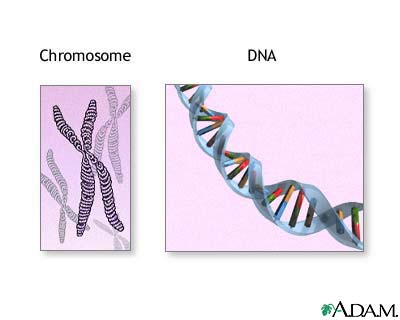
Fragile X syndrome is caused by a change in a gene called FMR1. A small part of the gene code is repeated several times in one area of the X chromosome. The more repeats (also called gene expansion), the more likely the condition will occur.
The FMR1 gene makes a protein needed for your brain to function properly. A variant in the gene makes your body produce too little of the protein or none at all.
Boys and girls can both be affected, but because boys have only one X chromosome, a single fragile X expansion is likely to affect them more severely. You can have fragile X syndrome even if your parents do not have it.
A family history of fragile X syndrome, developmental problems, or intellectual disability may not be present.
Symptoms
Behavior problems associated with fragile X syndrome include:
- Autism spectrum disorder
- Delay in crawling, walking, or twisting
- Hand flapping or hand biting
- Hyperactive or impulsive behavior
- Intellectual disability
- Speech and language delay
- Tendency to avoid eye contact
Physical signs may include:
- Flat feet
- Flexible joints and low muscle tone
- Large body size
- Large forehead or ears with a prominent jaw
- Long face
- Soft skin
Some of these problems are present at birth, while others may not develop until after puberty.
Family members who have fewer repeats in the FMR1 gene may not have intellectual disability. Women may have premature menopause or difficulty becoming pregnant. Both men and women may have problems with tremors and poor coordination.
Exams and Tests
There are very few outward signs of fragile X syndrome in babies. Some things that your health care provider may look for include:
- Large head circumference in babies
- Intellectual disability
- Large testicles after the start of puberty
- Subtle differences in face features
In females, excess shyness may be the only sign of the disorder.
Genetic testing can diagnose this disease.
Treatment
There is no specific treatment for fragile X syndrome. Instead, training and education have been developed to help children affected with fragile X syndrome function at the highest possible level. Clinical trials are ongoing (www.clinicaltrials.gov) and looking at several possible medicines to help with the symptoms of fragile X syndrome.
Support Groups
More information and support for people with Fragile X condition and their families can be found at:
- National Fragile X Foundation -- fragilex.org
Outlook (Prognosis)
How well the person does depends on the amount of intellectual disability.
Possible Complications
Complications vary, depending on the type and severity of symptoms. They may include:
- Recurrent ear infections in children
- Seizure disorder
Fragile X syndrome can be a cause of autism or related disorders, although not all children with fragile X syndrome have these conditions.
Prevention
Genetic counseling may be helpful if you have a family history of this syndrome. All pregnant women and those planning a pregnancy should be offered genetic screening for fragile X syndrome.
Related Information
ChromosomeIntellectual disability
References
Bennett AE, Schuster M. Fragile X syndromes. In: Kliegman RM, St. Geme JW, Blum NJ, et al, eds. Nelson Textbook of Pediatrics. 22nd ed. Philadelphia, PA: Elsevier; 2025:chap 59.
Gregg AR, Aarabi M; ACMG Professional Practice and Guidelines Committee, et al. Screening for autosomal recessive and X-linked conditions during pregnancy and preconception: a practice resource of the American College of Medical Genetics and Genomics (ACMG). Genet Med. 2021;23(10):1793-1806. PMID: 34285390 pubmed.ncbi.nlm.nih.gov/34285390/.
McIntire SC, Nowalk AJ, Garrison J, eds. Zitelli and Davis' Atlas of Pediatric Physical Diagnosis. 8th ed. Philadelphia, PA: Elsevier; 2023:chap 1.
National Institutes of Health. National Center for Advancing Translational Sciences. Genetic and Rare Diseases Information Center website. Fragile X syndrome. rarediseases.info.nih.gov/diseases/6464/fragile-x-syndrome. Updated July 2026. Accessed March 6, 2026.
BACK TO TOPReview Date: 7/28/2025
Reviewed By: Anna C. Edens Hurst, MD, MS, Associate Professor in Medical Genetics, The University of Alabama at Birmingham, Birmingham, AL. Review provided by VeriMed Healthcare Network. Also reviewed by David C. Dugdale, MD, Medical Director, Brenda Conaway, Editorial Director, and the A.D.A.M. Editorial team.
 | A.D.A.M., Inc. is accredited by URAC, for Health Content Provider (www.urac.org). URAC's accreditation program is an independent audit to verify that A.D.A.M. follows rigorous standards of quality and accountability. A.D.A.M. is among the first to achieve this important distinction for online health information and services. Learn more about A.D.A.M.'s editorial policy, editorial process and privacy policy. A.D.A.M. is also a founding member of Hi-Ethics. This site complies with the HONcode standard for trustworthy health information: verify here. |
The information provided herein should not be used during any medical emergency or for the diagnosis or treatment of any medical condition. A licensed medical professional should be consulted for diagnosis and treatment of any and all medical conditions. Links to other sites are provided for information only -- they do not constitute endorsements of those other sites. No warranty of any kind, either expressed or implied, is made as to the accuracy, reliability, timeliness, or correctness of any translations made by a third-party service of the information provided herein into any other language.
© 1997-
2026 A.D.A.M., a business unit of Ebix, Inc. Any duplication or distribution of the information contained herein is strictly prohibited.
All content on this site including text, images, graphics, audio, video, data, metadata, and compilations is protected by copyright and other intellectual property laws. You may view the content for personal, noncommercial use. Any other use requires prior written consent from Ebix. You may not copy, reproduce, distribute, transmit, display, publish, reverse-engineer, adapt, modify, store beyond ordinary browser caching, index, mine, scrape, or create derivative works from this content. You may not use automated tools to access or extract content, including to create embeddings, vectors, datasets, or indexes for retrieval systems. Use of any content for training, fine-tuning, calibrating, testing, evaluating, or improving AI systems of any kind is prohibited without express written consent. This includes large language models, machine learning models, neural networks, generative systems, retrieval-augmented systems, and any software that ingests content to produce outputs. Any unauthorized use of the content including AI-related use is a violation of our rights and may result in legal action, damages, and statutory penalties to the fullest extent permitted by law. Ebix reserves the right to enforce its rights through legal, technological, and contractual measures.
